
The Economics of Dedicated Freight Corridors: Cost Arbitrage, Supply Chain Velocity, and Multimodal Friction
Executive Summary
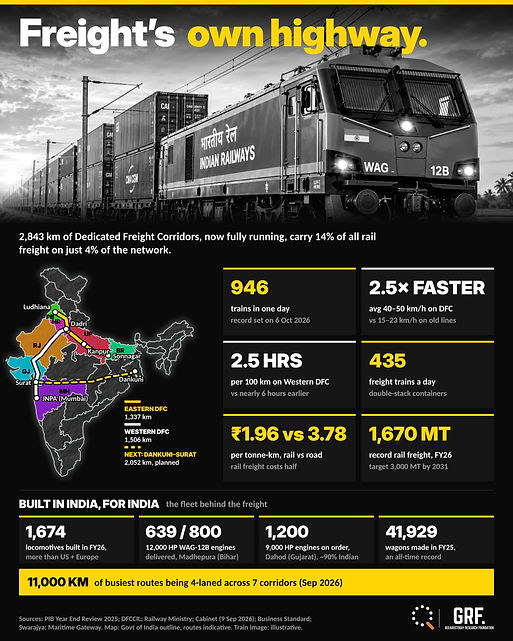
India’s establishment of Dedicated Freight Corridors (DFCs) represents a fundamental structural reform in macro-logistics infrastructure. The network encompasses two main arterial routes: the Western DFC, stretching 1,506 kilometres from Dadri in Uttar Pradesh through Haryana, Rajasthan, and Gujarat to Jawaharlal Nehru Port Trust (JNPT) in Navi Mumbai, Maharashtra; and the Eastern DFC, extending 1,337 operational kilometres from Ludhiana in Punjab through Haryana, Uttar Pradesh, and Bihar (Sonnagar), with terminal links extending through Jharkhand towards Dankuni in West Bengal. By systematically uncoupling heavy industrial freight transport from legacy passenger routes, DFCs address long-standing national throughput deficits, lower line-haul logistics expenditure, and enhance national trade competitiveness. This article provides a comprehensive evaluation of the economic dynamics surrounding DFCs, analyzing transport cost arbitrage, inventory velocity, macroeconomic spillovers, spatial distribution, and persistent systemic friction points.
For decades, the operational framework of Indian Railways prioritised passenger transit over freight movement due to socio-political imperatives. Consequently, cargo trains suffered severely depressed commercial speeds averaging between 15 and 20 km/h, forcing freight operators and manufacturing enterprises to rely heavily on road transport despite its significantly higher marginal cost per tonne-kilometre.
The establishment of segregated, heavy-haul railway lines creates substantial transport cost arbitrage across industrial value chains. Tariffs on Dedicated Freight Corridors fall to approximately ₹1.96 per tonne-kilometre, contrasting sharply with highway trucking rates averaging ₹3.78 per tonne-kilometre. By nearly halving line-haul transport expenditure for primary commodities—such as thermal coal, iron ore, finished steel, cement, and bulk agricultural produce—DFCs lower baseline production costs across manufacturing sectors. In macroeconomic terms, mitigating input transport costs directly relieves pressure on the Producer Price Index, creating a structural anti-inflationary buffer that ultimately stabilizes downstream retail prices for end consumers.
Beyond direct tariff differentials, the primary economic return of DFC infrastructure stems from dramatic improvements in commercial velocity and capital productivity. Segregated track geometry and automated signalling permit freight speeds to increase by two and a half times, elevating average commercial velocities to 40–50 km/h. Furthermore, purpose-built heavy-haul infrastructure accommodates double-stack container formations and higher axle loads, substantially magnifying payload throughput per train path. On peak operational days, network throughput has exceeded 946 trains in a single twenty-four-hour cycle.
From an enterprise supply chain perspective, elevated throughput velocity directly improves capital efficiency. Reduced transit times compress order-to-delivery cycles and diminish arrival variance. Enterprise supply chain managers are consequently able to reduce buffer and safety stock holdings across regional distribution warehouses, releasing working capital that was previously locked in pipeline inventory. The resulting increase in capital turnover improves overall corporate balance sheet productivity.
Logistics costs in India have historically consumed between 13 and 14 percent of Gross Domestic Product, generating a persistent cost penalty when evaluated against developed economy benchmarks of 8 to 9 percent. High-capacity freight corridors serve as a core structural lever to narrow this competitiveness gap.
Direct high-speed connectivity between inland manufacturing clusters and maritime gateway ports drastically reduces container turnaround times. This operational acceleration lowers terminal storage charges, demurrage penalties, and carrying costs for exporting firms, enhancing the price competitiveness of Indian goods in international markets. Crucially, DFCs foster spatial equity by linking landlocked northern and central states—including Punjab, Haryana, Rajasthan, and Uttar Pradesh—to western ocean ports in Gujarat and Maharashtra. This alignment effectively neutralises geographical disadvantages for inland industrial hubs. Additionally, shifting fourteen percent of total national rail freight onto DFC infrastructure, which accounts for only four percent of total track length, yields a vital decongestion dividend by freeing up track capacity on legacy lines for faster, safer, and more reliable passenger transport.
A rigorous economic appraisal of Dedicated Freight Corridors must also account for persistent structural friction points that hinder maximum efficiency realization. High line-haul speeds achieved on dedicated tracks are frequently negated by bottlenecks at terminal interfaces, inadequate road feeder networks, and delays in local drayage services. If first-mile collection and last-mile distribution remain constrained by urban road congestion, total logistics cost savings diminish.
Furthermore, freight traffic across Indian regions exhibits pronounced structural asymmetry. Heavy bulk raw materials travel predominantly westward and northward from eastern mineral extraction belts in West Bengal, Jharkhand, and Bihar towards northern industrial centres. However, return traffic frequently lacks equivalent cargo density, resulting in under-utilised or empty wagon returns that burden railway operating margins. Finally, the segregation of freight onto independent corridors disrupts historical cross-subsidisation practices, wherein inflated freight tariffs subsidised under-priced passenger fares, requiring a comprehensive re-alignment of railway tariff structures and public fiscal support.
Conclusion
The Dedicated Freight Corridor network represents a landmark realignment of national freight movement, successfully overcoming trunk-line capacity bottlenecks and providing critical cost relief to shippers. However, fully unlocking the economic potential of DFCs requires expanding beyond line-haul rail efficiency. Sustained macroeconomic benefits will depend on seamless integration with multimodal logistics parks, modernised last-mile road access, and targeted industrial policies designed to balance regional freight flows.


Comments